
Should I Work Part-Time Before I Fully Retire?
Dear Erica,
I’m 63 and starting to think seriously about retirement, but I’m not sure I’m ready to stop working completely. I’ve been wondering about cutting back to part-time for a year or two first as a way to ease into retirement. Is that a smart move financially, or am I just making things more complicated?
Dear Considering Part-Time,
Retirement doesn’t have to happen all at once.
What you’re considering is sometimes called a phased retirement: working fewer hours for a period of time before retiring completely. For some people, it can be a good way to gradually transition into retirement.
The first question is whether your finances give you that option.
1. Start With What You Need Each Month
Before reducing your hours, look at what would happen when your paycheck gets smaller.
Would your part-time income still cover your regular expenses? If not, how much would you need to take from your savings each month?
Then consider what else might change. Would you lose health insurance or other benefits? Would you contribute less to your retirement accounts?
You don’t need a complicated calculation to get started. You simply want to understand what comes in, what goes out and where you would get the difference.
2. Part-Time Work Can Give Your Savings More Time
One potential benefit of working part-time is that you may not need to take as much money from your retirement savings right away.
Here’s a simple example.
Imagine two people who each have $1 million saved at age 62 and expect to need $60,000 a year from their investments in retirement.
One stops working completely at 62 and begins taking $60,000 a year from her savings.
The other works part-time until 65 and earns enough to cover half of her expenses. During those three years, she only needs to take $30,000 a year from her savings. At 65, she fully retires and begins taking $60,000 a year.
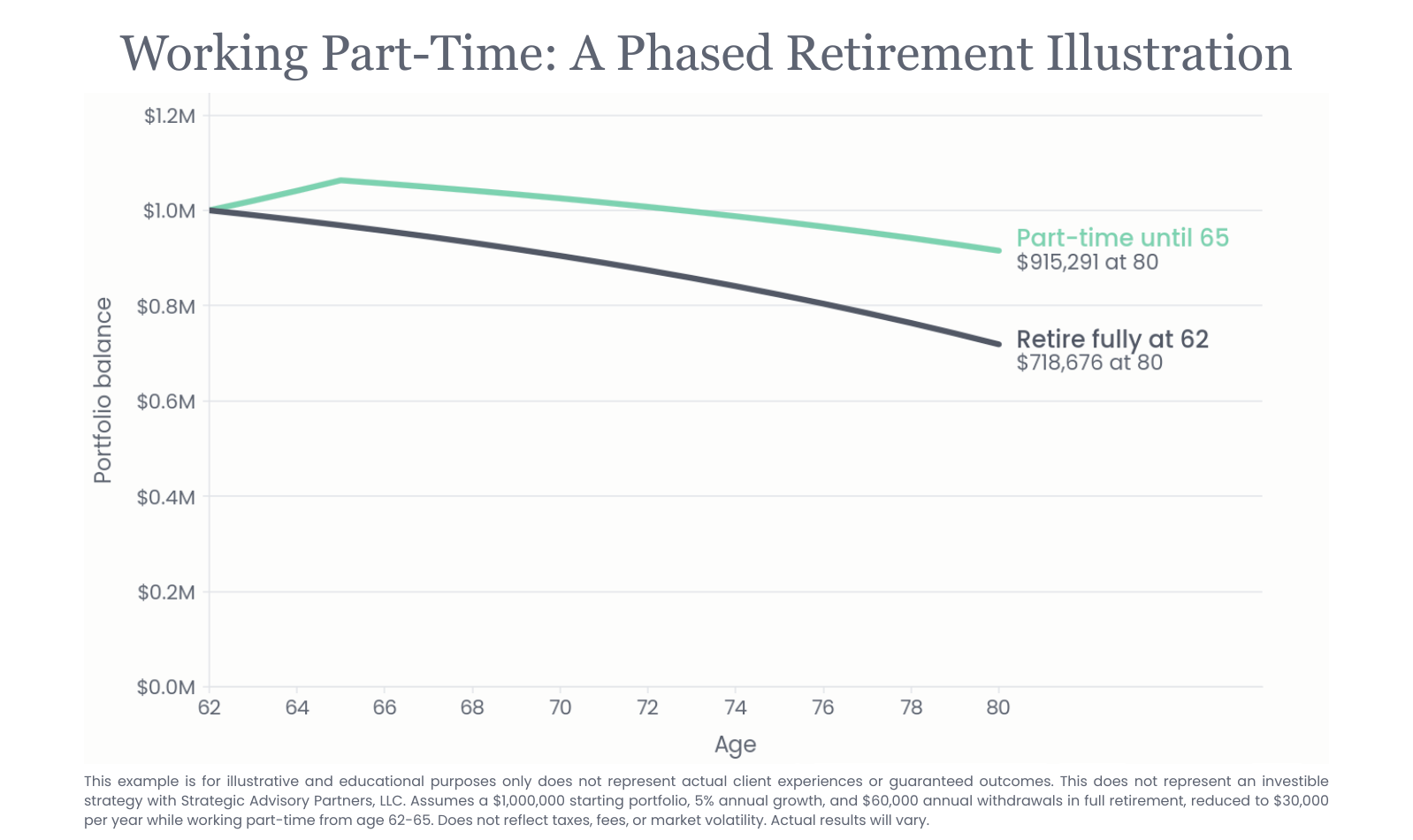
By age 80, the person who worked part-time has about $915,000, compared with about $719,000 for the person who retired completely at 62. That’s a difference of nearly $200,000.
She didn’t invest differently or start with more money. She simply took less from her savings during those first few years, giving more of her money time to stay invested.
Of course, real life won’t look this smooth. Investments don’t grow at a steady rate every year, and taxes, inflation, fees and market ups and downs can all affect the outcome.
The point of the example isn’t that working part-time will produce this exact result. It’s that even a few years of needing less from your savings can make a meaningful difference over time.
3. There Is More to Retirement Than the Money
Retirement is also a big life change.
Work can provide routine, purpose and social connection. Some people are ready to leave all of that behind. Others like the idea of having more free time without giving up work completely.
Working part-time can give you a chance to find out what you want retirement to look like.
You may discover that working two or three days a week gives you the balance you were looking for. Or you may decide you’re ready to retire completely.
Either choice can work. The important thing is having the financial flexibility to choose.
4. Give Yourself Options
Before reducing your hours, I would want to answer four questions:
Can you comfortably live on your part-time income?
If you need money from savings, how much will you need?
What happens to your health insurance and other benefits?
Would your finances still work if you decide to retire sooner than planned?
Once you know those answers, you can make the decision based on more than a feeling or a retirement date on the calendar.
The Bottom Line
Working part-time before you fully retire may help your finances, but money is only one part of the decision. The right choice is the one that works financially and gives you the balance of work, time and flexibility you want.
Maybe working longer means having more money later. Maybe working less now gives you something you value more: time.
There isn’t one answer that’s right for everyone. What matters is understanding what each choice means for you.
A financial advisor can help you compare your options and see how each one could affect your retirement, so you can make an informed decision based on your own priorities and circumstances.
Financial questions don't always have simple answers, but chances are someone else is wondering the same thing.
Use the form to submit a question you'd like Erica to answer in a future Ask Erica article. While we can't provide personalized financial advice through the blog, your question may be featured anonymously in an upcoming post to help others navigating similar situations.

About Erica Lyall
CFP®, CDFA® | Financial Advisor
Erica Lyall is dedicated to helping people build confidence and clarity in their financial lives, particularly during times of change. Having experienced divorce herself and seen family members navigate similar challenges, Erica understands the emotional and financial complexities that come with major transitions. Her passion is helping clients find stability, independence, and renewed purpose through sound financial planning.
As both a CERTIFIED FINANCIAL PLANNER™ and a Certified Divorce Financial Analyst™, Erica partners closely with clients and their professional teams, including attorneys and tax professionals, to create comprehensive strategies that align with long-term goals. Her approach blends technical expertise with empathy, helping clients make informed decisions and move forward with confidence.
With more than 20 years of experience in wealth management and philanthropy, Erica has built trusted relationships with individuals and families focused on their legacies and financial well-being. Before joining Strategic Advisory Partners, she served as a Wealth Management Advisor at BB&T (now Truist) and at boutique firms such as Hutchinson Family Offices, where she specialized in supporting women through divorce and beyond.
Erica earned her B.A. in Economics and Spanish from Wake Forest University. She lives in Lewisville with her son, family, and pets, and enjoys volunteering and being active in her community.
This material is provided for informational and educational purposes only and should not be construed as individualized investment, tax, or legal advice. The opinions expressed are those of Strategic Advisory Partners as of the date published and are subject to change without notice. All investing involves risk, including the possible loss of principal.
Any statistics or third-party information referenced are believed to be reliable but cannot be guaranteed for accuracy or completeness. Examples provided are illustrative and for illustrative purposes only and do not represent actual client experiences or guaranteed outcomes.
Retirement planning strategies should be evaluated based on an individual’s unique financial situation, goals, and risk tolerance. Before making financial decisions, individuals should consult with their financial, tax, and legal professionals.
Strategic Advisory Partners is an investment adviser registered with the U.S. Securities and Exchange Commission. Registration does not imply a certain level of skill or training. More information about Strategic Advisory Partners’ investment advisory services can be found in its Form ADV Part 2 or Form CRS, which is available upon request.